01
Drag a Fingernail Down the Seam After a Year
Run a thumb around the top ring after a year of caster hits. At 5mm the welded wire still reads as a circle, not an oval that drops a liner.
Welded steel wire, 10 to a carton
SHSYCER mesh trash cans replace the bin that dents by spring, holding 4.7★ to 4.8★ across 96 verified buyer reviews.

Buyers comparing these baskets against a 3mm big-box bin kept returning to what a caliper and a kitchen scale confirm. The difference that decides a reorder shows up at the rim, not on the spec sheet.
Run a thumb around the top ring after a year of caster hits. At 5mm the welded wire still reads as a circle, not an oval that drops a liner.
Tip a half-full cup into the basket on a Tuesday morning and the sealed disc bottom keeps the spill off hardwood.
Clip it with a desk chair caster and the basket rocks upright again, carrying twice the steel of the usual 0.6 lb bin.
Rounded top wire and welded seams let a full liner lift clear on the first pull, no torn corner at the lip.
The black finish takes a break-room splash and stays black, because powder coating bonds to steel where spray paint chips off.
Glance down from a standing desk and the wire grid shows a half-full basket, so the liner goes out before shredded paper spills across the floor at 5 p.m.
SHSYCER builds the same welded steel frame into every body, from the compact 4 gallon round to the square 6 gallon. Slide the square one along a wall until it wedges into the corner, then park a round one in the open aisle beside a desk where nothing squares up against it.
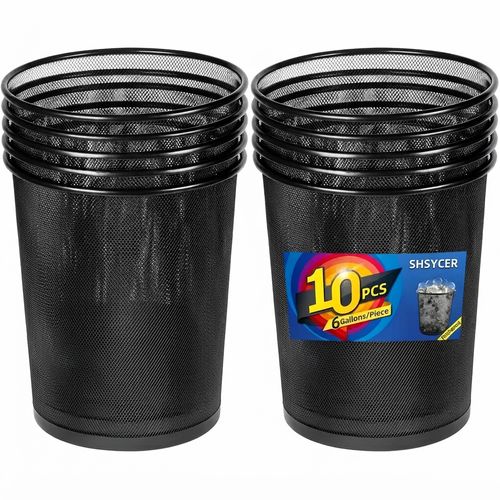
Drop a day of shredded misprints into the 6 gallon round body and the welded rim holds its circle, even after a chair caster clips it twice a week. Weight does the rest. At 1.2 lbs per basket, twice a 0.6 lb wire bin, it rocks and settles instead of dumping across the carpet. Where a spray-painted bin flakes at the welds after one humid summer, the powder-coated black finish stays intact under a damp cloth. Ten baskets ship in one carton with foam spacers between them. Twist them apart the day they land, and a dented unit goes back inside the 30-day retailer window.
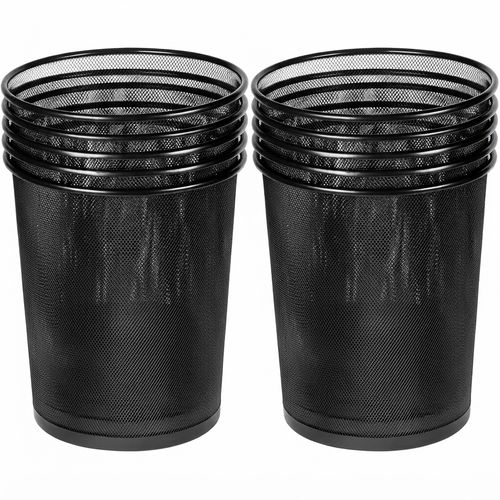
A 4 gallon round body slides into the narrow gap between a dorm desk and a wardrobe, where a larger basket blocks the drawer swing. The narrower rim is also the one generic grocery bags actually fit. Tuck the handles under the rounded edge and a full liner lifts clear without tearing at the corner. Where a molded plastic bin traps damp paper against a sealed wall, the ventilated mesh grid dries it out between empties. It is the smaller round body, so measure the gap beside the desk before choosing between 4 and 6 gallons.
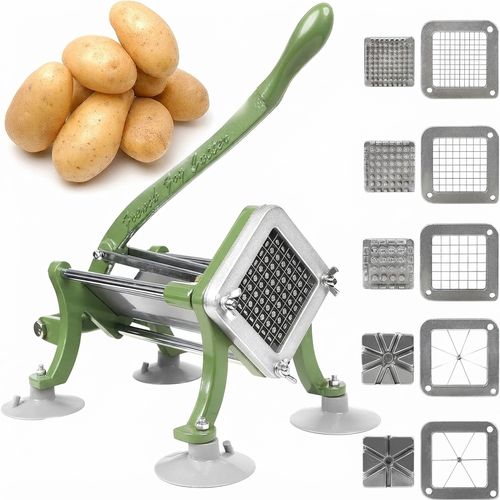
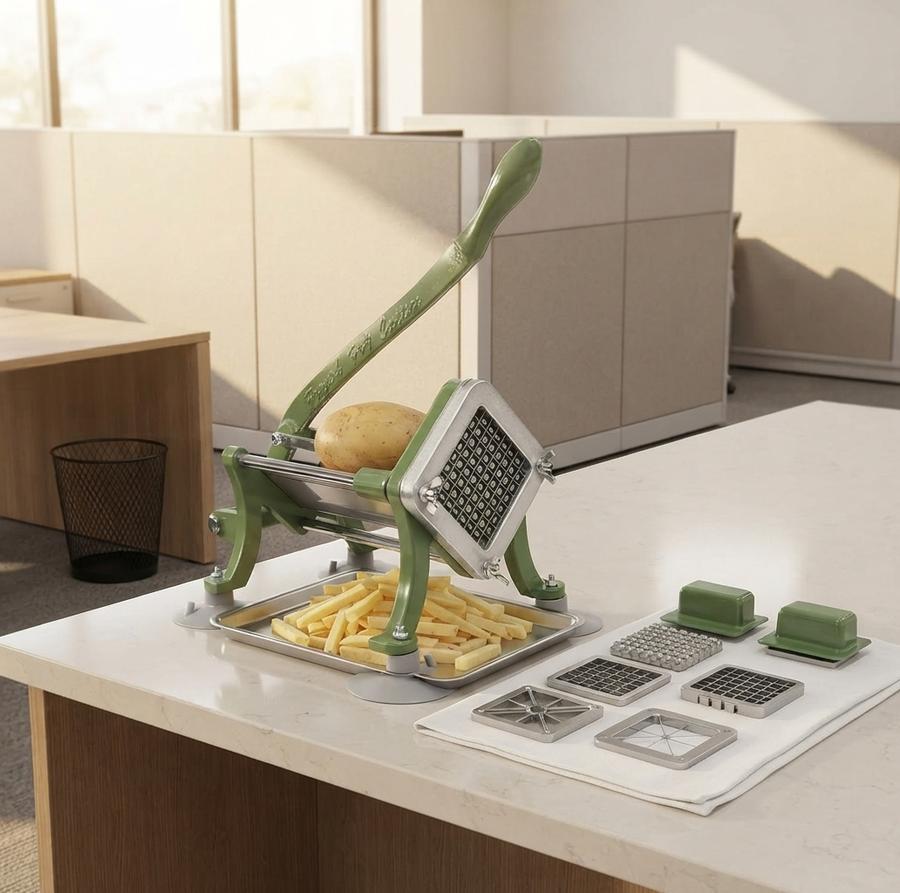
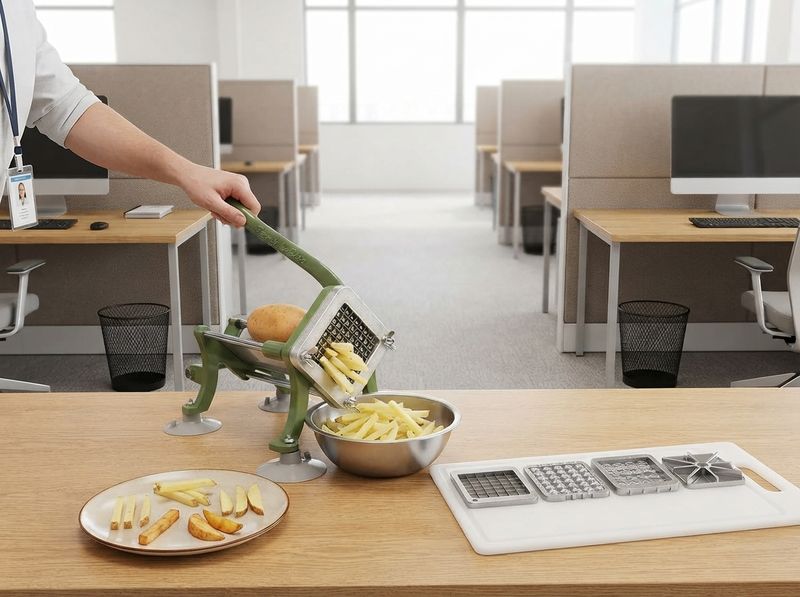
Press a whole russet through the quarter-inch grid and the cast iron handle drops it into fries in one stroke, with no sawing at the skin. Four suction feet lock the frame to a prep counter, so at 15.2 lbs it stays put through a full sack instead of walking toward the edge. Where a plastic-hinged cutter snaps under a hard potato, the aluminum push head and stainless blades carry the force. Swap in the #6 or #8 plate and the same frame cuts carrots and zucchini for a Friday service. It sits on the kitchen-tool side of SHSYCER rather than with the mesh baskets.
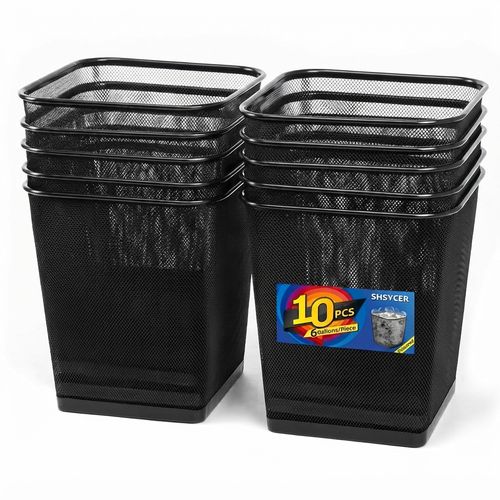
Push the square 6 gallon body into a corner and both flat sides meet the wall, closing the wedge of dead floor a round basket leaves behind. Four raised bulges under the solid disc base spread grip wider than three, which matters on the polished tile in a lobby or a break room. Where a flat-bottom bin skates a foot on one kick, this one holds its outline through a full workday of traffic. Rated 4.8 stars by verified buyers, the top score among the mesh bodies, it is the one to pick when the floor plan runs to corners rather than open aisles.
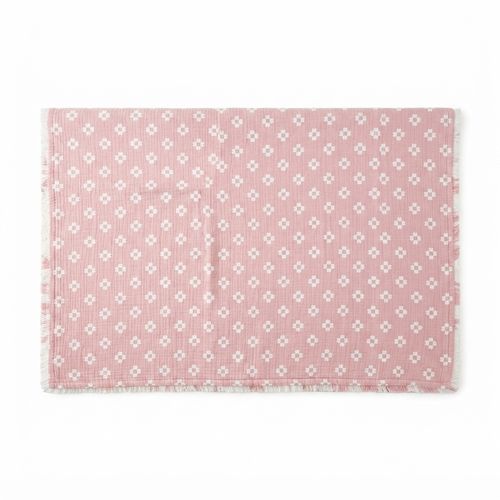
Pull this two-layer muslin blanket over a guest bed and 59 by 78 inches of Twin coverage lands corner to corner, one pattern facing up and a second waiting on the flip side. The two cotton layers sit loose against each other instead of compressing into a solid wall of fiber, which is how the weave keeps moving air on a warm night. Where a fleece throw traps body heat and forces a kick-off by midnight, this one stays put on a hot sleeper through an August week. Wash it on a normal cycle and it comes back softer, and note that this one sits on the bedding side of SHSYCER rather than with the mesh baskets.
SHSYCER prints a wire gauge, a unit weight, and a verified review count that most mesh bin spec sheets leave blank.
| Measured figure | What it changes in use | Source |
|---|---|---|
| 5mm frame, 60% thicker than 3mm | Set a caliper on the top ring and read 5mm of welded steel, where the mesh bins stacked at a big-box store measure 3mm.Open two mesh bin spec sheets side by side and scroll for the gauge line: one prints 5mm, the other stops at sturdy steel construction. | Manufacturer spec: 5mm welded frame against the 3mm industry-standard gauge |
| 1.2 lbs per basket, against 0.6 lb bins | Put one on a kitchen scale before it ever holds trash and the needle stops at 1.2 lbs, where the bins an office restocks yearly read 0.6.Search a competing product page for the word tip and the claim comes back; search the same page for a weight in pounds and nothing answers. | Manufacturer spec: 1.2 lb measured unit weight |
| 3 raised bulges on a solid disc base | Run a hand under the base and feel the molded bulges bite into polished tile, the detail that keeps a loaded basket where you set it when the bag shifts.Flip a competing bin over in a store aisle and count the bulges yourself, because neither the count nor the base shape reaches the printed spec sheet. | Manufacturer spec: solid disc base with raised non-slip bulges |
| 4.7★ to 4.8★ across 96 verified reviews | Office and dorm buyers who have run these baskets for months rate them 4.7 to 4.8 stars, tracked across 96 verified purchase reviews.Tap the star rating on a competing page and you often land on a total that folds in unrelated products, with no way to see how many buyers own the bin itself. | 96 verified buyer reviews across our mesh trash can models |
| Powder-coated, not spray-painted | Leave one in a basement copy room through a wet August and the powder-coated black surface holds, where spray paint lifts at the weld points first.Read a rust-resistance claim on a competing bin, then hunt the same page for the words powder-coated and you scroll to the footer without finding them. | Manufacturer spec: powder-coated finish rather than spray paint |
SHSYCER engineered these baskets for the rooms where bins fail early: shared hallways, humid break rooms, printer stations, dorm desks.
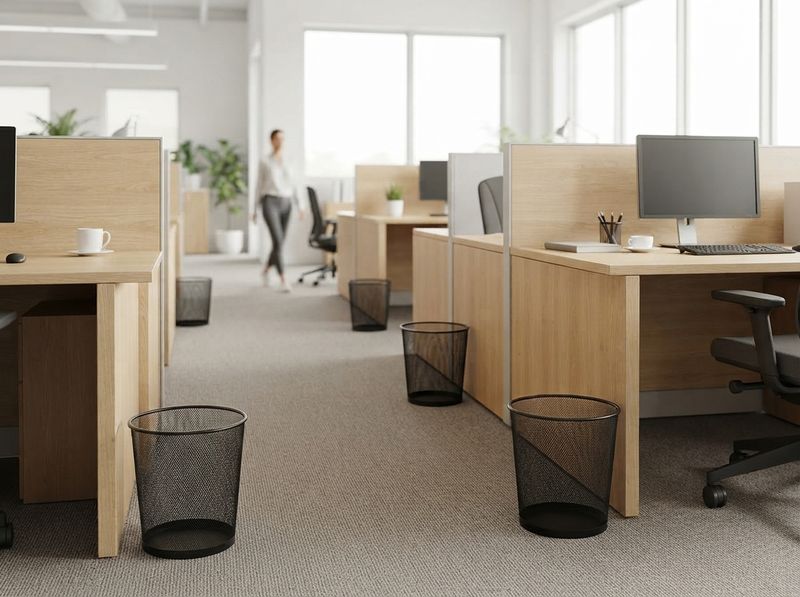
A 5mm welded wire ring runs around the top of every SHSYCER basket, where most office bins stop at 3mm. That rim is what a rolling chair hits first. Catch it with a caster twice a day in a narrow cubicle aisle. The circle stays a circle, instead of folding into an oval that a liner no longer grips.

Push a loaded basket across polished lobby tile and the 3 raised bulges under its solid disc base hold it in place. Beside a printer that shove repeats a dozen times a shift, and a bin without grip ends up under someone else's desk by Friday. A cup tipped into the liner at 9 a.m. pools on the disc bottom instead of soaking the carpet tile underneath.

Smooth, rounded top edges and welded seams let a standard grocery bag clear the 6 gallon rim without catching, the failure most office bins hit weekly. Buyers do flag one thing honestly. A generic grocery bag needs a firm tug to seat around the wider rim, and a bag cut too small will rip at the corner on the way up.

At 1.2 lbs empty, a SHSYCER basket carries twice the ballast of the 0.6 lb wire bins offices restock every year. Weight is the whole trick in a shared corridor. A mail cart clips the bin at hip height, the base rocks and settles, and nobody stops to pick yesterday's paper up off the floor.

Your desk bin takes a knee from a rolling chair twice a week. These welded wire baskets shrug it off. The frame keeps its round shape, the solid base keeps spilled coffee off the carpet, and the coating keeps rust off the seams. Ten baskets ship in one carton, ready to place the hour you open it.
Cheap wire wastebaskets bend at the rim within a month, and 3mm wire warps the first time a chair leg catches it.
You have replaced one of those already, most likely, which is why the spec sheet matters more than the product photo you are looking at. SHSYCER sells these baskets inside Home and Kitchen storage and organization, under the names shoppers actually type: mesh office trash can, metal wire wastebasket. Against a solid plastic bin the difference is structural. An open wire body ventilates where a sealed shell traps moisture, so damp paper dries out instead of souring by Friday afternoon.
A department buyer outfitting a floor of desks pulled a single 10-pack, set a 6 gallon basket at every station and one in the copy room, and called the construction solid at the end of the run, where thin baskets tip whenever a chair backs up.
One thing to know before you order: liner bags are not included, and a generic grocery bag needs a firm tug to seat on the wider rim. Your fix takes a second, and the questions below name the bag size that seats clean on each body.
How this brand startedSHSYCER ships all 10 baskets welded and nested in one carton, so the only setup left is twisting them apart and dropping in the first liner.
Cut the tape and lift the whole stack onto the floor in under a minute, foam spacers still sitting between the baskets.
Grip the lower rim, give the top basket a quarter turn, and lift it free. A nested pair separates in about two seconds, with no prying at the lip.
Drop a standard grocery bag into the 4 gallon body and tuck the handles under the lip. The film then holds square through a full day of paper without creeping back up the rim.
Set it on the tile beside a doorway and load a day of paper into it. The weighted bottom grips, so a passing foot cannot skate it under the next desk.
Buyers who ordered a carton for an office floor, a dorm room or a vegetable bed describe what held and what did not.
We put one at every desk on the second floor and the construction is solid where the last set was not. Nothing on the floor holds a bag as well for the money, and I hate plastic bins that crack at the rim. These sit heavy enough that a chair backing up nudges them instead of knocking them over. Two of the ten arrived with a dent in the rim, so check the carton the day it lands rather than a month later.
I bought these for garden use rather than the office, and they have been perfect for the job. I drilled a couple of holes into outdoor pots and zip-tied a basket over each seedling so the deer could not reach them. Once the plants got bigger and less appealing to the critters, I stacked the baskets in the shed for next year. They are bigger and better built than the chicken-wire cages sold specifically for this.
Good value, good look, good construction. Fair warning, I was buying them upside down as plant cloches and did not notice the solid disc bottom until they arrived. That bottom is exactly what you want under a desk and exactly what you do not want over a seedling. I am using them anyway with a drill and five minutes per basket. For office use I would order again without hesitating.
We purchased these for our offices and they are perfect. Fantastic quality for the price, and the packing was better than expected with styrofoam blocks between each basket. The only real complaint is that a few arrived with small dents, not bad enough to stop us using them. They are slightly smaller than I pictured, but the listed dimensions were clear, so that one is on me.
Cute and small for every single desk in the office, and something different from always getting the round ones. The two flat sides tuck into a corner where a round basket leaves a wedge of dead floor. Good rubbish bins overall. My only wish is that they sold smaller quantities, because I now have four extras stored in the basement waiting for the next hire.
Sturdy, does the job, and the mesh lets me see the fill level from a standing desk. The liners that came in the box are a joke. They do not fit around the rim easily, and if you fight one on long enough to seat it, the bag rips at the corner. Ordinary kitchen bags in the right size work fine on the 4 gallon body, so buy your own liners and skip the frustration.
Works as it should. Sturdy build, suction cups hold well to a clean smooth surface, cutting blades are sharp and easy to change, and the whole thing wipes clean. If you plan to use it heavily, mount a piece of plywood to the wall studs, pull the suction feet out and bolt the cutter through those same screw holes. Saves a lot of prep time compared with a knife and a cutting board.
Originally I bought one for my son's dorm room because he is a hot sleeper. Good natural materials, nice style, and it held up over three years of serious wear and washing. He needed a new one at home so I bought a second in the other pattern. It washes and dries very well and comes out softer each time. Light enough for August, warm enough for a spring night.
SHSYCER buyers raise the same worries before committing to a 10-pack, and two of those worries deserve an honest caveat.
Sealed plastic bins hold humidity against damp paper, and by midweek a cubicle picks up that sour edge. The open mesh grid ventilates on all sides, so a wet coffee filter dries instead of fermenting. Empty it Friday and there is nothing left to scrub.
1.2 lbs per basket vs 0.6 lbs typical
Doorway traffic knocks a 0.6 lb basket over about once a week, and yesterday's paper ends up under the desk. A heavier steel body takes the same hit and rocks back down. The gripped bottom stops it skating across laminate on the way.
Buyers flag this one plainly: a few baskets in a 10-pack ship wedged tight, and one or two can arrive smashed at the rim. Hold the lower basket, turn the top one a quarter turn, and it releases. A unit that arrives bent qualifies for return.
Generic liners are not cut for a wide 6 gallon rim, and reviewers describe fighting a bag onto the lip until it tears. Tuck the handles under the rounded edge instead of stretching them over the top. On the 4 gallon body a grocery bag seats without the fight.
Buying ten of anything from a brand you have never handled is the real hesitation, and no warranty term is printed anywhere in the product data. What does exist is concrete: a 30-day return window through the retailer, plus SHSYCER's own customer-service promise of a fast replacement when a unit arrives damaged. Check all ten the day they land, then pick a size to compare specs.
A bent rim on arrival goes back inside the 30-day retailer window. Pick a capacity, then compare the round and square bodies.
SHSYCER baskets show up in cubicle aisles and copy rooms, but reviewers keep finding a second job for them outdoors.
The 4 gallon body tucks into the gap between a desk leg and a filing cabinet, and the weighted bottom keeps it from sliding out when a chair rolls back.
Paper waste piles up fast beside a copier. A 6 gallon body swallows a day of misprints, and the open mesh shows at a glance whether it needs emptying before you walk over.
Flip a basket over a bare-root seedling and stake it down. Reviewers describe drilling the base for in-ground use against gophers and zip-tying bodies to garden pots through a whole growing season.
Line a shelf with the square bodies and store mason jars, cleaning bottles, or coiled cables. Open wire means you see what is inside without pulling the container down first.
A school orders one set and covers ten classrooms with matching bins. Rounded rims mean no cut wire ends where students reach in for a discarded worksheet.
SHSYCER baskets arrive fully assembled, so the first day costs you a box cutter and about ten minutes of placement.
Cut the carton open, twist the 10 baskets apart, and check every rim for a shipping dent. A bent unit goes back inside the 30-day retailer return window.
By Friday the desk-side baskets have taken a caster hit or two, and the welded rims still hold a liner square at the lip.
Wipe the first coffee ring out of the bottom with a damp cloth. The powder-coated surface releases it without a scouring pad.
Two winters into a humid break room, the black finish shows scuffs but no rust bloom at the welds, where spray-painted bins flake first.
Ready for Day 1? The 4 gallon round body clears a dorm desk drawer swing.
Forty-seven answers grouped from what buyers ask before and after a carton lands, starting with the ones asked most.
A mesh trash can is an open-top wastebasket welded from steel wire instead of molded from a plastic shell. The grid ventilates, so a coffee-soaked napkin dries out between empties rather than souring at the bottom of a sealed bin. Offices, classrooms, copy rooms, and residence halls buy them because paper waste is bulky, light, and better seen than hidden. SHSYCER sells them ten to a carton in 4 and 6 gallon bodies, which suits a buyer outfitting a whole floor rather than one desk.
Two capacities cover the range: a 4 gallon round body measuring 10 inches long by 8 wide by 11 tall, and a 6 gallon body offered in both round and square. The round 6 gallon stands 13 inches at the rim; the square version stands 12 and tucks flat against a corner. Every capacity ships as a set of ten.
One desk runs comfortably on the 4 gallon body, which fills in about a week for someone discarding paper, wrappers, and the occasional cup sleeve. Take the 6 gallon if the desk sits near a printer, because paper waste is bulky and light: a 4 gallon basket beside a copier fills by Wednesday. Measure the gap first. The 4 gallon stands 11 inches and slides between a desk leg and a wardrobe, while the 6 gallon round needs 13 inches of clearance under a work surface.
Wire gauge and unit weight are the two measurable gaps. The frame welds up from 5mm steel where the standard mesh bin uses 3mm, a 60% difference you can feel at the rim. Each basket weighs twice what a typical wire bin does, which is why it settles after a bump instead of tipping.
5mm of welded steel at the reinforced frame, against 3mm on a standard mesh wastebasket. That 60% difference is what keeps the top ring circular after a rolling chair catches it.
1.2 lbs empty, roughly twice a typical 0.6 lb wire bin. The mass sits low in the solid steel disc base rather than in the mesh walls, which is the whole mechanism behind tip resistance.
Published warranty terms do not exist for this line, and inventing one here would help nobody. What is documented instead: the retailer's standard 30-day return window applies to every set, and SHSYCER's own customer-service line promises a fast replacement when a unit arrives damaged. Check all ten baskets the day the carton lands rather than a month later.
Thirty days from delivery, through the retailer's standard policy. Twist-test all ten baskets the day the carton lands: a unit found crushed in week six falls outside the window even though shipping caused it.
Damaged arrivals are the most common issue reported, usually a rim crushed where units nested tightly in transit. A bent unit qualifies for return inside the 30-day window, and the brand's stated service promise covers a fast replacement. Photograph the dent before you separate the stack, because that documents the condition it shipped in.
Dry paper waste needs no liner, and running bare is why many buyers pick mesh in the first place. Wipe the body out every few weeks and it stays clean. Anything wet, greasy, or fine enough to slip through the grid needs a bag. Liners are not included with any set.
Grocery bags are the standard liner for a desk-side basket, and the 4 gallon body takes one straight on. The 6 gallon rim is wider, so reviewers describe needing a firm tug to seat the handles, and a bag cut too small will tear at the corner on the way up. Tuck the handles under the rounded lip rather than stretching them over.
Hold the lower basket firmly, turn the top one a quarter turn, and lift straight up. The taper that lets them nest for shipping is also what makes them stick. Reviewers report a few units in a set wedging tight, and occasionally one arrives crushed at the rim. Work through all ten on delivery day while the return window is open.
Ten matches how the baskets get bought. An office manager covering a floor of desks, a school covering classrooms, or a gardener covering a row of seedlings all need matching units in one order. Buyers who want fewer sometimes keep the extras in storage, and reviewers say so plainly. If one desk is all you need, the set is oversized for you.
Open-top by design, and no lid is sold to fit any body. The grid keeps damp paper drying rather than fermenting against the sealed wall of a closed plastic bin.
Shape changes where the basket fits and how it grips. The round 6 gallon stands 13 inches and suits an open floor or a desk side, where nothing constrains the outline. The square 6 gallon stands 12 inches, meets two walls flush in a corner, and carries four non-slip bulges under the base instead of three. Capacity is identical. Choose on floor plan rather than volume: corners and alcoves take the square, aisles and desk sides take the round.
Mesh trash cans are the core line, and the ones this site is built around. The same brand also sells a commercial French fry cutter and a two-layer muslin cotton blanket, carried on the same storefront but unrelated in category and construction. Nothing about the fry cutter or the blanket informs how the wire baskets are built.
The 4 gallon round measures 10 inches long by 8 wide by 11 tall. The 6 gallon round measures 12 by 9 by 13. The 6 gallon square measures 11 by 8 by 12. Upper and lower widths differ because the bodies taper, which is what lets them nest in the carton for shipping.
Powder coating, bonded to the welded steel under heat rather than sprayed on wet. A chair-leg scuff burnishes instead of peeling down to bare metal, where a spray-painted shell starts its first rust spot.
The bottom is a solid steel disc, not open mesh, so a tipped coffee cup pools inside the basket instead of running through onto carpet tile. Wipe it out with a damp cloth and the powder-coated surface releases the ring in one pass. Sustained liquid still needs a liner; the base contains a spill, it does not store one.
Three on the round bodies, four on the square, molded into the solid disc base. They bite on tile, laminate, and polished marble; on carpet the pile already holds the basket.
Fine debris does pass through an open grid. Sharpener shavings, staples, and shredded confetti will find the holes and land on the floor under the basket. A standard grocery bag liner solves it completely and costs nothing, which is how most desk-side owners run them. Paper, wrappers, and cups need no liner at all.
Top rims are rounded and the mesh seams weld smooth, so no cut wire ends sit where a hand reaches in. That is also what stops a liner from snagging on the way out.
Coated steel resists rust, it does not become stainless. The powder coat is a sealed barrier, so an intact finish holds through humid break rooms and residence hall rooms without blooming. Rust starts where the coating gets breached, usually a deep gouge from a dropped object. Dry the basket after washing and the finish keeps doing its job.
A soaked stack of paper is heavy, and the welded frame handles it without flexing when you lift the liner straight up. The failure point on thin-gauge bins is the rim rather than the body: a thin-gauge ring bows outward under load and stops holding the bag square. The thicker welded ring does not move.
Available online through the brand's own storefront, which is where the verified reviews and the current price both live. Pricing moves week to week, so check today's price on the product page for your selected capacity rather than trusting a number printed here. Pick a capacity first, then compare the round and square bodies side by side.
Every set ships under the SHSYCER name, with SHSYCER listed as manufacturer. Verify on arrival: 5mm at the rim, 1.2 lbs on a kitchen scale, and a coating that burnishes rather than flakes.
Baskets nest inside one carton with foam spacers between them, which reviewers specifically call out as well packed. Nesting is also why some units arrive wedged tight and occasionally crushed at the rim. The spacers reduce that; they do not eliminate it, which is what the return window and the replacement promise are for.
Contact goes through the seller's customer-service channel on the product page, which is the same route the fast-replacement promise runs through. Count the baskets before you break down the carton and keep the packing material until the count checks out. A short set documented on delivery day resolves faster than one reported in week three.
Verified buyer reviews, 96 of them across the mesh bodies, averaging 4.7 to 4.8 stars. That count excludes the brand's fry cutter and blanket, whose hundreds of reviews say nothing about wire.
Flipping a basket upside down over a young plant is one of the most common uses reviewers describe, against rabbits, deer, birds, and grasshoppers. The mesh passes sun and rain while blocking the animal. Note the base is solid, so upside-down placement caps the plant unless you drill it, which is what in-ground users do for gophers.
Paper recycling is what the open grid suits best. The mesh keeps a stack ventilated and shows the fill level from across the room, so nobody hauls a half-empty container to the dock. Running two bodies side by side, one for waste and one for paper, works because they are visually identical and stack the same in storage.
Open wire makes a decent visible-storage container for mason jars, cleaning bottles, or coiled cables on a shelf. You see the contents without pulling the container down and checking. The square body lines up flush along a shelf edge where round bodies leave gaps between them. Weight is the limit, since the base holds contents rather than distributing them.
Powder-coated steel handles humidity better than a spray-painted bin, and residence hall and bathroom placement both show up in buyer use. The finish is the whole defense, so a deep gouge in a damp garage is where a rust spot eventually starts. Nothing here carries a weatherproof or corrosion certification, and we are not going to imply one.
School and dorm placement are both listed uses, and the reasons are the rounded rim and the weight. Nothing sharp meets a hand reaching in, and the heavier steel body absorbs the knock it gets in a room full of backpacks. One set covers ten classrooms with matching bins, which is why schools order at this quantity.
Open mesh vents rather than concentrates. A sealed plastic bin traps humidity against damp paper, which is what produces the sour smell by midweek in a small room. Airflow through the grid dries a wet coffee filter instead. Food waste is the exception: an open basket will not contain a smell that a closed bin at least delays.
Buyers do leave them outdoors, mostly as plant guards through a growing season, then store them for winter. That is the honest boundary. The powder coat resists rust, but no outdoor or weatherproof rating is published for this line, and permanent year-round exposure is beyond anything the brand claims. Seasonal outdoor use with winter storage matches what reviewers actually report.
Coated steel wins on shape retention; heavy-duty plastic wins on impact tolerance. A plastic bin flexes and springs back after a hard kick, while a thin metal bin can hold that dent for the rest of its life. The comparison flips at the thicker gauge, where the frame is stiff enough to resist the dent instead of absorbing it. Two other differences matter in a hallway: plastic holds odor in the wall material over time, and a scuffed coating burnishes where a cracked plastic rim stays cracked.
Airflow and sightlines are where mesh pulls ahead for paper. A solid shell traps humidity against a damp stack, and you cannot judge the fill without walking over and looking in. Mesh gives up containment in exchange: pencil shavings and staples drop through the grid, and a liner bag closes that gap for a few cents a week. For a printing office the trade favors mesh. For wet food scraps it does not, and a sealed container is the right call.
Stainless resists corrosion at the material level and costs considerably more. Powder-coated steel resists it at the surface, which holds until the coating is breached by a deep gouge. For an indoor office, a break room, or a dorm, coated steel matches stainless in practice. For a wet outdoor installation the gap becomes real.
Sixty percent more steel is the difference, measured against the gauge those bins typically use. Squeeze both rims and the thin one gives. In practice the gap appears at the top ring, since that is what a chair caster, a knee, and a cart wheel all hit first. A bowed ring stops holding a liner square.
A thrift bin costs less and arrives with a history nobody wrote down: rust starting under a chipped coating, a rim already bowed out of round, or a base bent out of flat. Wire gauge is almost never stamped on an old bin, so the one specification that predicts how long it lasts cannot be checked at the counter. Buying new means the gauge, the unit weight, and the coating method are all on the page before you order ten of them.
Commercial bins are engineered for abuse a home office never delivers: loading-dock traffic, hourly emptying, and cleaning chemicals stronger than anything under a kitchen sink. They cost several times more and rarely suit a desk visually. For a home or small office, a thick-gauge coated wire body sits at the point where more spending buys durability nobody will use up. Spend the difference on a second basket for the garage instead.
Warm water, dish soap, and a stiff brush clear the grid faster than a cloth, because open mesh gives the bristles somewhere to go. A foaming spray cleaner also penetrates the holes well. Rinse thoroughly, since soap residue left in the grid attracts dust. Dry the basket fully before it goes back beside a desk.
A water and white vinegar spray neutralizes most of it, and a full wash with dish soap and a stiff brush handles the rest. Open mesh helps here, since there is no sealed cavity holding the odor and the body air-dries completely. A smell that returns within days usually means food waste is going in without a liner.
Dry the basket after any wash and keep it out of standing water. Rust starts at breaches in the coating, so the practical step is avoiding deep gouges rather than treating the metal. If a spot does appear, fine steel wool lifts it and a light wax or oil seals the exposed metal against the next humid week.
A bowed rim can often be worked back by hand, since welded steel wire bends before it breaks. Support the opposite side and press slowly rather than snapping it. A crease at a weld point is a different problem and will not return to true. Damage present on arrival belongs in a return, not a repair.
The bodies nest, which is how ten fit in one carton, so unused units store flat on a closet shelf. Gardeners use that taper to put a season of plant guards away each autumn.
Cubicle aisles, copy rooms, lobby tile and a prep counter, photographed at working height.



SHSYCER welded mesh bins, 10 to a carton
Check today's price